Happy Anniversary Blog!

Showing posts with label amino acids. Show all posts

May 20, 2013

Biochem Badass 101 page 12

a-mean-o-acid-crop
MORE ON PROTEINS AND AMINO ACIDS!
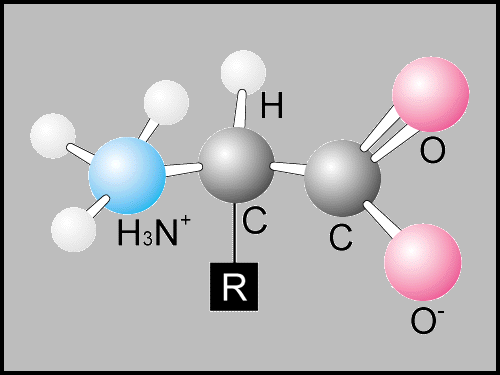
Amino Acids and Proteins were one of the 3 bio-molecules we studied in class. Amino acids are defined as a simple organic compound containing both a carboxyl (COOH) and an amino (NH2) group. Proteins are defined as any of a class of nitrogenous organic compounds that consist of large molecules composed of one or more long chains of amino acids and are an essential part of all living organisms. Amino acids have the basic structure seen in the diagram where R can be given by different groups (highlighted in red). The central carbon is referred to as the Alpha carbon.
aminoacids R groups
There are 20 essential Amino acids for survival which can be classed as either Essential or Non-Essential Amino Acids.

An Essential amino acid is one that is required by animals that cannot be synthesize by them and must be supplied in the diet. (marked)
Non essential amino acids are those that are synthesized by the body. (unmarked)
20AminoAcids


Furthermore Essential Amino Acids can be described as either Complete Proteins or Incomplete Proteins.  Complete proteins contain all 10 essential amino acids and are derived from animal sources while Incomplete proteins lack one or more of the essential amino acids and most a vegetable based.

How are Amino acids and Proteins classed by structure?

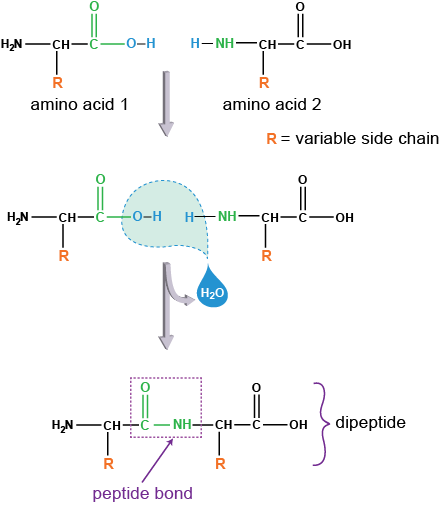
Amino acids bond together to from Proteins. These bonds are called peptide bonds.  As a result of bonding Amino acids can be arranged into the following long chain structures;
Peptide- short polymer of amino acids
Di-peptide- contains 2 amino acids joined by a peptide bond.
Tri-peptide- a molecule with 3 amino acids joined by peptide bonds.
Polypeptide- a macro-molecule containing many amino acids.
Protein- a biological molecule of molecular weight 5000g/mol that is made up of polypeptide chains.


peptide bond


How can we identify Amino Acids from Proteins?

We can use to chemical tests to determine which compounds are amino acids or proteins. These are the Ninhydrin Reaction and the Biuret Test.

Ninhydrin reacts with amino acids to from a Purple colour imino derivative. This derivative is a positive test for amino acids which are commonly colourless.
ninhydrin
The Biuret test involves using biuret reagent which is light blue in colour. It contain Copper(II) ion in an alkaline solution. Biuret turns purple when mixed with a solution contain proteins. Biuret reagent  interacts with peptide bonds of proteins. The purple colour formed is a positive test for proteins.
biuret


Credits to Biochem students Carlos, Shenelle, Liniker, Latisha, et. al


How are Proteins classed in terms of structure?

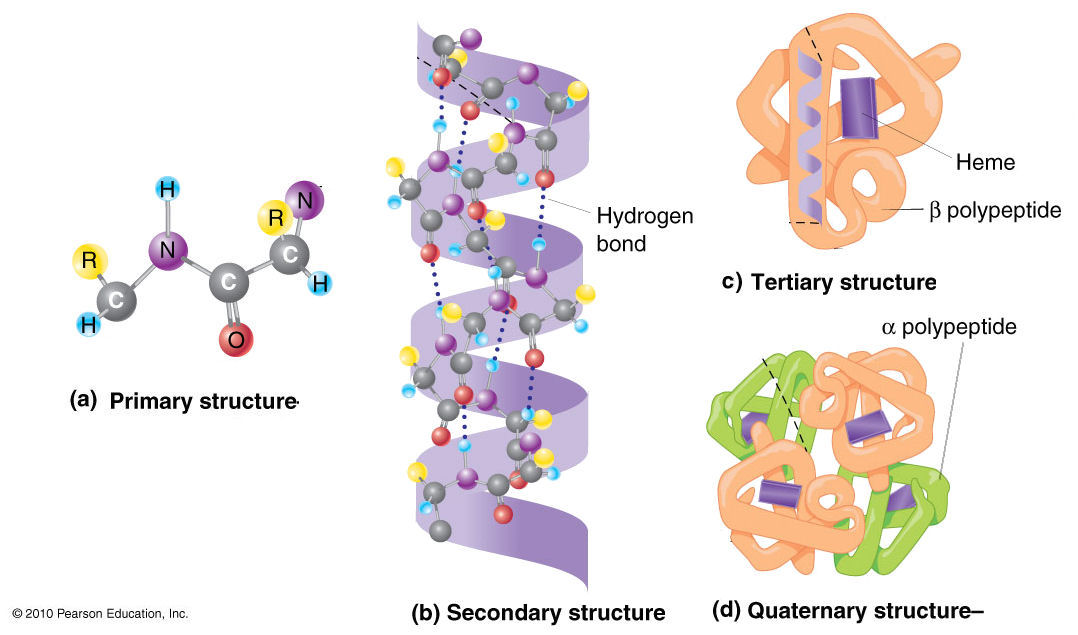
Proteins are classed by the arrangement and the number of polypeptide chains it contains and the level of folding that occur. Protein folding occurs due to Hydrophobic Interactions, Ionic Bonding, Hydrogen bonding and Disulphide bonding.  Protein structure can be either Primary, Secondary, Tertiary or Quaternary.

Primary structure: the linear arrangment of amino acids in a protein and the location of covalent linkages such as disulfide bonds between amino acids. These Disulphide bonds are not denatured.

Secondary structure: areas of folding or coiling within a protein; examples include alpha helices and Beta pleated sheets, which are stabilized by hydrogen bonding.

Tertiary structure: the final three-dimensional structure of a protein, which results from a large number of non-covalent interactions between amino acids.

Quaternary structure: non-covalent interactions that bind multiple polypeptides into a single, larger protein. Hemoglobin has quaternary structure due to association of two alpha globin and two beta globin polyproteins.


Protein Structure

Folding can be denatured in several ways.

Heat and Ultra Violet Radiation-Hydrogen bonds are broken by increased translational and vibration energy
Strong Acids/Bases- salt formation, disruption of hydrogen bonds
Urea- competion for hydrogen bonds
Agitation-shared hydrogen bonds

Some Organic Solvents- change in dielectric constant and hydration of ionic groups.

Proteins are essential to body function and are useful in life processes. An example of an important protein structure is an Enzyme.

“Definition of terms .” USA rice. http://www.usarice.com/index.php?option=com_content&view=article&id=629&Itemid=258.
“Essential Amino acid.” wordnet web. wordnetweb.princeton.edu/perl/webwn?s=essential%20amino%20acid.
“The Structure of Proteins.” arbl.cvmbs.colostate.edu. http://www.vivo.colostate.edu/hbooks/genetics/biotech/basics/prostruct.html.








Biochem Badass 101 page 11


AMINO ACIDS AND PROTEINS
Image
Hey guys now i was watching this video on amino acids and proteins and the first thing that i remembered was that amino acids are the subunits of proteins. Remember when we did glucose and we talked about Monosaccharides and stuff well yea its similar to that. Now the professor said that a protein looks like a slinky. Image
Which i thought was funny but then i remembered the toy and was like “O yea it really does look like that!!!!!!”.
The structure of an Amino Acid
AminoAcidLG
The Amino Acid contains 4 groupings of elements attached to its central carbon atom or alpha carbon (Ca) which can form 4 covalent bonds to itself, they are:
  1.  An Amino group- (NH3+)
  2. A Carboxylic acid group-  (COO-)
  3. A Hydrogen atom- H
  4. A alkyl or aryl group (R) which can be as simple as just an H atom or something as complex as (CH2CH(CH3)2.
There are 20 different types of Amino Acids based on what is the (R) group so here you can see how many different combinations of amino acid there are to synthesize different proteins.
When these amino acids bond via peptide bonds or otherwise they can form either; Primary Structures, Secondary Structures, Tertiary Structures or Quaternary Structures.
biobook_biomol_25
Based on the diagram you can see that a water molecule is removed. In the video the professor called that Dehydration Synthesis which he said enables the two amino acids to snap together. Now i think this term sounds more complex than the term I’m accustom to which is Condensation. When i hear dehydration i think of drying out or the lost of water and the synthesis part which means coming together for me. So in a nut shell Dehydration Synthesis means the coming together of 2 amino acids by the removal of a water molecule. So for the reverse, to break up the polypeptide chain into amino acid units you add water via Hydrolysis.
NB: ALL PROTEINS CONTAIN PEPTIDE BONDS.
Image
These other structures contain different types of bonds and only when they contain these specific bonds that they go to the next level of structure.
  • Primary Structures: they will have peptide bonds.
  • Secondary structures: contains peptide bonds,hydrogen bonds, which occurs between the R groups of the amino acids as a result the structure folds.
  • Tertiary Structures: peptide bonds, hydrogen bonds, the main bondage Hydrophobic interactions which is responsible for the structures 3-D shape, electrostatic forces and sometimes covalent disulphide bonds.
  • Quaternary Structures: peptide bonds, hydrogen bonds, Hydrophobic Interactions, electrostatic forces and sometimes covalent disulphide bonds. Now the Quaternary Structure is made up of more than one polypeptide chain where it is referred to as a spatial arrangement.

PROTEINS
Proteins

DIFFERENCE BETWEEN FIBROUS AND GLOBULAR PROTEINS
Difference between Fibrous and Globular Proteins

AMINO ACIDS
Amino Acids

Amino acids are an organic group consisting of an amine group and a carboxylic group. Amino acids are subunits of protein. Only 20 amino acids are used to make proteins in the body. They are classed as being essential and non-essential amino acids. Essential amino acids cannot be synthesized by the body therefore it must be supplied in the diet. Examples of some essential amino acids are histidine, leucine, lysine, and methionine. Non-essential amino acids are those that can be synthesized by the body and are produced in the body in certain functions. Example of some non-essential amino acids are alanine, asparagine, aspartic acid, glycine, serine and cysteine.
Image

Image
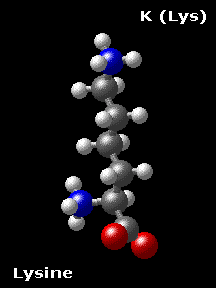
Lysine is an essential amino acid in humans. Lysine is a nutritional requirement in our bodies. Some good sources we can get Lysine from are meat, egg, soy ,cheese and certain fish like sardines.
Also, L-Lysine is a building block for all the proteins in the body. It plays a major role in calcium absorption, building muscle protein and the body’s production of enzymes, hormones and antibodies.

My wordle :)

Credits to Biochem students Carlos, Shenelle, Liniker, Latisha, et. al

Related Posts Plugin for WordPress, Blogger...